Ethereum Makes History With Majority Of Supply Staked – What It Means For Price And Network

bitcoinistPublished on 2026-02-20Last updated on 2026-02-20

Abstract

Ethereum has reached a historic milestone with over 50% of its total supply now staked, marking the first time such a level has been achieved. This significant reduction in liquid supply may decrease selling pressure and increase market sensitivity to new demand, potentially supporting long-term price dynamics. Despite recent price declines, with ETH falling below $2,000, the growing staking activity reflects strong conviction among long-term holders. Meanwhile, on-chain metrics suggest the market has cooled to levels that have historically preceded periods of accumulation and potential future expansion.

While buying interest in Ethereum may be losing momentum, the staking ecosystem has been experiencing significant growth over the past few months. Following a period of steady rise, the quantity of ETH locked away in staking contracts has reached a critical landmark that could impact its market outlook.

Over Half Of All Ethereum Now Staked

Ethereum’s price has fallen below the $2,000 mark once again as Wednesday drew to a close. During the waning price action, the network seems to have reached a historical inflection point, as shown by the massive staking ecosystem growth.

In an X thread, Everstake, a leading and responsible validator, has outlined a crucial landmark for ETH, which could play a role in shaping its future. ETH staking activity just exploded, with more than half of the entire supply being locked away in staking, marking the first time in its history. With the switch to proof-of-stake, Ethereum’s staking participation has increased steadily. However, its economic design enters a new phase when it surpasses the 50% of all supply.

Everstake’s report is solely derived from data from Santiment, a popular on-chain data analytics platform. Data from the platform shows that the proof-of-stake contract on Ethereum now controls 50.18% of the total historical ETH issuance. Beyond just being a remarkable figure, it represents a key milestone in the project’s 11 history. In other words, this implies that the majority of ETH is no longer circulating or active in the market.
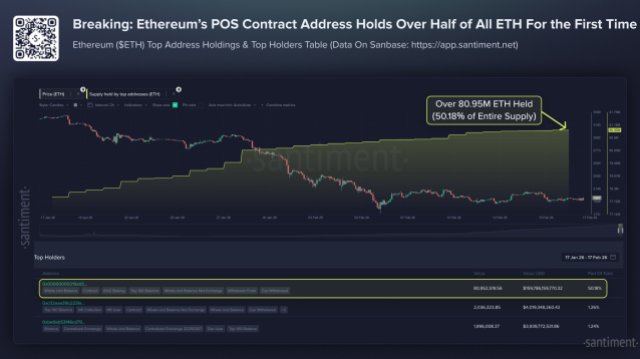
More than half of ETH is in staking contracts | Source: Chart from Everstake on X

When over 50% of the supply is being locked away in staking contracts, the liquid supply reduces, and fewer coins become available for trading. Such patterns often ignite sentiment as they decrease selling pressure and create a market sensitivity to new demand. At the same time, the development indicates conviction from long-term holders.

Users are determined to secure the network rather than carry out trades in short-term volatility. Everstake remains confident that this is a structural shift for Ethereum. It’s reducing supply coupled with steady or growing demand points to robust price dynamics for ETH over time. “It doesn’t guarantee an immediate pump, but it changes the foundation the price is built on,” the firm stated.

A Market That Has Fallen Into Cold Levels

After an analysis of the MVRV Z-Score, RVT, and NUPL, Alphractal disclosed that the Ethereum market temperature is near cold levels. Specifically, this key metric measures whether the market is overheated or oversold, providing insights into risk-elevated periods and when asymmetry favors long-term positioning.

When it gets close to zero or falls below, it indicates that the market has calmed down. Historically, readings below 0 typically precede a phase where risk and speculative are flushed, increasing the potential for long-term accumulation even as price declines.

These zones underscore periods of reduced unrealized profits, triggering a balanced valuation and removing emotional excess from the market. In the past, major expansion phases have been preceded by extended positions in cold temperature zones, as weaker participants gradually exit and stronger hands progressively accumulate.

ETH trading at $1,981 on the 1D chart | Source: ETHUSDT on Tradingview.com

Related Questions

QWhat historical milestone has Ethereum recently achieved according to the article?

AEthereum has achieved the historical milestone of having more than half (50.18%) of its total supply staked for the first time in its history.

QWhich data analytics platform's data was used by Everstake in its report on ETH staking?

AEverstake's report was derived from data provided by Santiment, a popular on-chain data analytics platform.

QWhat is one potential market effect of having over 50% of ETH supply locked in staking contracts?

AIt reduces the liquid supply available for trading, which can decrease selling pressure and create market sensitivity to new demand.

QAccording to the article, what does a market temperature near 'cold levels' (as measured by MVRV Z-Score, RVT, and NUPL) indicate for Ethereum?

AIt indicates that the market has calmed down, with reduced unrealized profits and emotional excess, which historically precedes phases where risk is flushed out and there is potential for long-term accumulation.

QWhat was the price of Ethereum mentioned at the time the article was written?

AEthereum was trading at $1,981, having fallen below the $2,000 mark.

Related Reads

From Spring Festival Gala Robots to the Computing Power Energy War: Why Does China Hold the 'Trump Card' in the AI Era?

China's 2026 Spring Festival Gala showcased a breakthrough in embodied AI, featuring robots from companies like Magic Atom, Unitree, and Galaxy General performing complex tasks such as dancing, martial arts, and comedy. This demonstrated China's advanced progress in robotics and AI physical integration. Meanwhile, the U.S. faces an escalating energy crisis, with electricity prices rising 36% by early 2026. Training AI models like GPT-4 consumes power equivalent to 100,000 households annually, and U.S. data centers are projected to use 600,000 GWh by 2028. Aging infrastructure, fragmented grids, and lengthy approval processes for new transmission lines exacerbate the problem. In contrast, China has built a strategic advantage through decades of infrastructure investment. It operates 45 ultra-high-voltage (UHV) power transmission projects, spanning 40,000 kilometers, efficiently delivering clean energy from the west to eastern data centers. Renewable energy accounts for over 60% of China’s power capacity, with 40% of electricity coming from green sources. China also dominates transformer production, holding 60% of global capacity. While the U.S. excels in AI algorithms, China’s robust energy infrastructure—UHV grids, renewable energy, and manufacturing capacity—provides a foundational edge in the AI era, turning energy into a critical competitive asset.

marsbit11m ago

From Spring Festival Gala Robots to the Computing Power Energy War: Why Does China Hold the 'Trump Card' in the AI Era?

marsbit11m ago

Trading

Spot
Futures

Hot Articles

Discussions

Welcome to the HTX Community. Here, you can stay informed about the latest platform developments and gain access to professional market insights. Users' opinions on the price of ETH (ETH) are presented below.

活动图片